


Ok, so I got all aerated about “clinically proven”; now let’s get into “medical grade”, which is bandied about with similar zeal by brands.
What does “medical grade” actually mean?
Given that we’ve established that “clinically proven” is a completely meaningless phrase1, it shouldn’t shock you to discover that medical grade also means…
Literally nothing.
It’s yet another unregulated marketing ploy.
The term doesn’t guarantee strength, safety, effectiveness, or oversight. Although it certainly encourages you to infer it.
It’s often used to imply prescription strength
To be very clear on this: the only way to legally obtain prescription-strength skincare is to be prescribed it by a doctor.
A skincare brand, even one that’s doctor-owned, cannot sell you over-the-counter a strength or concentration of ingredient that you can only obtain on prescription.
Prescription products (like tretinoin or hydroquinone 4%) are classified as drugs or medicines, regulated by MHRA (UK) or the FDA (US).
“Medical grade” skincare still comes under the ‘cosmetics’ umbrella which means:
No requirement for clinical trials
No obligation to disclose concentrations
No need to prove efficacy before sale
Once again, for those at the back: if it doesn’t require a prescription, it’s not prescription strength, no matter what the packaging suggests.
Sometimes “medical grade” is code for “sold in clinics”, but that’s just a distribution choice
Many brands are labelled “medical” or “cosmeceutical2” because they’re sold via:
Dermatology clinics
Aesthetic practitioners
Medispas
But this is just a sales channel. It doesn’t mean the product itself is inherently stronger, better, or even evidence-based.
How on earth are you supposed to navigate this?
Well, you have me. And I have Notes3.
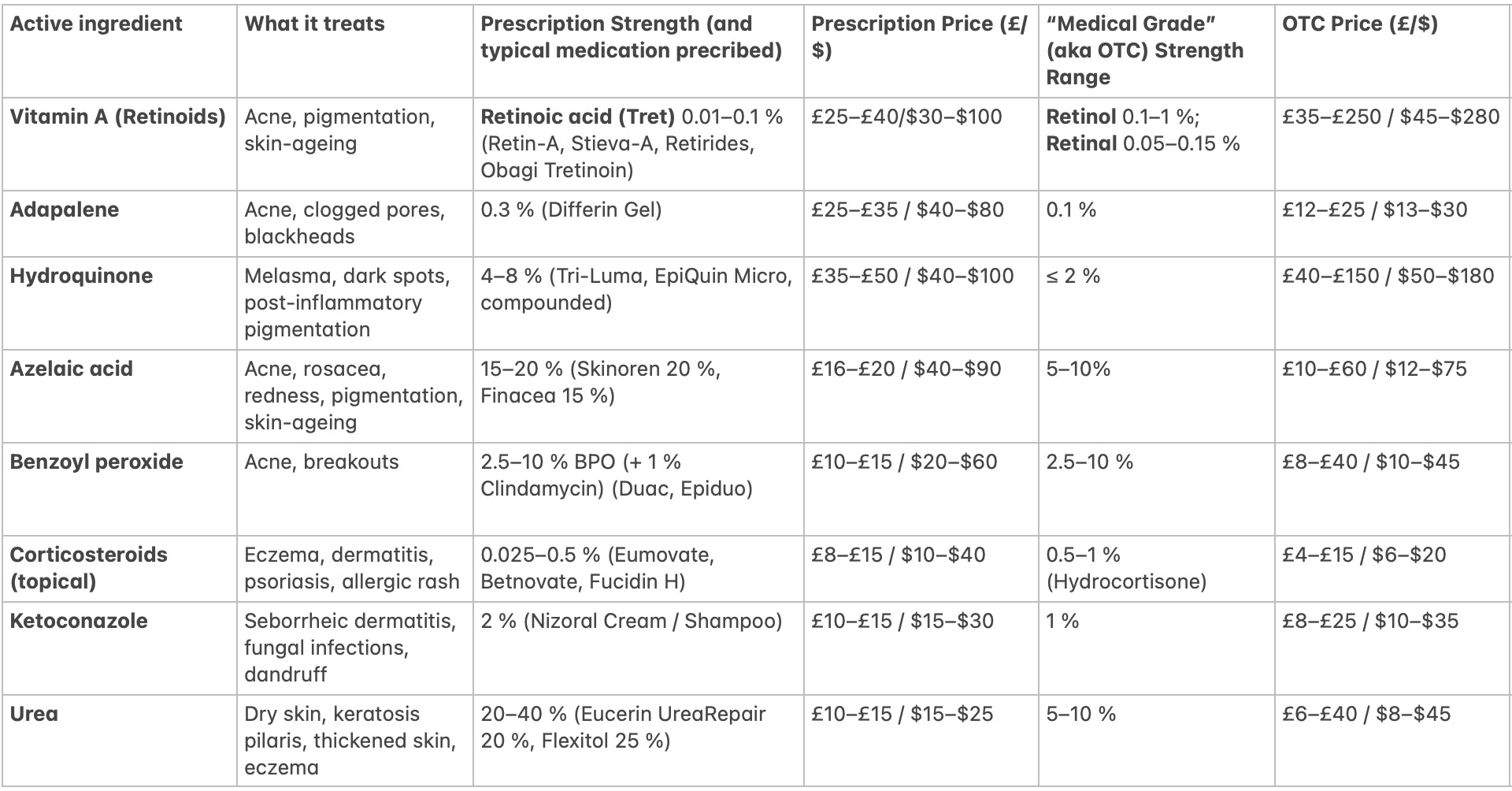
All UK prices assume a private prescription4.
Reminder about the Vitamin A concentrations: Retinoic acid is much stronger than retinol5. You need to use responsibly, but from a cost/benefits perspective, tret is a no-brainer here.

Why do I keep wanging on about azelaic acid and tret (retinoic acid)?
Because
Most women over 30 whom6 I know IRL are concerned about skin ageing.
Many women over 30 whom I know IRL are spending a lot of money on cosmetic anti-ageing skincare, when azelaic acid and tret are a) usually cheaper b) have verified anti-ageing results. They’re actually clinically proven and peer-reviewed and all that good stuff.
I, for many years, spent a lot of money on cosmetic anti-ageing skincare. I would like you to benefit from my realisation that I could spend a lot less and look even lovelier.
If you’re falling for ‘medical grade’ marketing, you might as well use actual prescription skincare.
So how do you buy actual prescription skincare?
I told you this over two years ago7.

But, because some of you seem to be pathologically avoidant of clickthroughs, here it is again8:
No cosmetic skincare can achieve the results that one or both of these products can.
I would therefore urge you to replace any cosmetic skincare products that you’re specifically using with the goal of reducing fine lines or wrinkles with prescription skincare instead. No matter what the advertising/nice lady at the counter told you.
In the UK/US/Aus, retinoids above 0.12% and Azelaic acid above 15% are only available on prescription.
In the UK and Australia, both of these are cheaper on prescription than the majority of - less effective - cosmetic skincare products. In the US, pricing will depend on insurance but is higher.
Superdrug/Boots online doctors - UK only
These are both amazing - you can order a private prescription of the contraceptive pill, testosterone, prescription skincare, the morning after pill, testosterone (for menopause) and sexual health tests/medications (and a bunch of other stuff) from them. It goes to a doctor for review and then you can either collect it in-store or they post it to you, often same-day.
You can buy azelaic acid 15% (Finacea) for £22 for 30g and retinoid 0.025% (Treclin) for £28 for 30g. 30g lasts me about 8 weeks of twice-daily use.
These are not on the usual Superdrug/Boots websites. The doctor service is its own portal. Links in the heading.
Dermatica/Skin and Me (UK) Curology/Apostrophe/Dermatica (US) Software (Australia)
All of these companies operate on the same principle: you fill in an online questionnaire/have an online consultation, send some photos and they send you a bottle of bespoke formula for £25-30/$30US/$54AUD a month that you apply once a day.
For treatment of fine lines and wrinkles, the formulation typically contains retinoid, azelaic acid and niacinamide and they scale up the dose over time depending on how you respond, which means you don’t have to work it out for yourself. The dispensers typically dispense an exact amount, so you don’t over-apply.
They also have formulations for acne, rosacea and hyperpigmentation.
In the UK and Australia you’re paying slightly more for the convenience of them creating a formulation for you than you would if ordering the products separately, but it’s still much cheaper than the majority of anti-ageing cosmetic skincare. And it has a much higher chance of reducing lines and wrinkles than anything else applied topically.
In the US, I’d say this is a no-brainer.
Bossy note #1
Reminder:
Only introduce one new product into your routine at a time.
Unless you have a reaction to it, monitor a new product’s results for a minimum of 6 weeks before forming an opinion
If you do react badly to a product, take note of what you were using it in conjunction with and at what stage you were in your menstrual cycle. If you’re keen to try it again, wait at least a week and then compare results, taking the above factors into account.
In all instances, allow at least 2 weeks before introducing another new product
SPECIFICALLY: Do NOT go disco nuts, buy 14 things without understanding what the ingredients do, use them all in one go for 3 days and then tell me you have a reaction to them/hated them all.
Bossy note #2
You should not start using prescription skincare without consulting a dermatologist, either online or in person.
Have a consultation with a derm (this will likely be online, might be via one of the 3rd parties listed above and will almost certainly require you to answer a questionnaire honestly) before buying or applying prescription skincare. FFS.
Bossy note #3
Don’t do what I did when I signed up for a similar service in the US and overstate the severity of your skin conditions so that they send you a more concentrated dose and/or apply the product more frequently than indicated, because you still believe more is better.
More is not better when it comes to skincare. Less is better.
All you’ll do is aggravate your skin, which will then take longer to repair in the long run.
Bossy note #4
A note on buying prescription skincare from an overseas online pharmacy website: don’t. It’s only £20-30 at home - why would you bother navigating this minefield?
A note on buying prescription skincare when you’re on holiday in Mexico (where it’s available without prescription): I would strongly advise against it, even in cities. There are department stores that have pharmacies in them, these should sell authentic products, but they’re likely to be expensive.
Mexico has become a hotspot for people to purchase prescription medication over the counter, and it’s going about as well as you’d imagine. I would not risk this any time soon.
Lovely things
I’m not here urging you to deny yourself delightful skincare treats. If you have an array of expensive products that are within your budget and are bringing you joy, then go about your joy, with my love and blessings.
But be smart about it - spending £16 on azelaic acid, instead of £100 on something with no proven benefits, enables me to buy myself more diamonds9. This is about allocation of resources, not parsimony10.
TLDR: If you want something ‘medical’, buy prescription skincare.
Until the next time! x


🤢
And Substack still doesn’t have a table function 🤦🏼♀️
NHS price is £9.90 at time of writing. It’s unlikely that you’ll get an NHS doctor to prescribe for anti-ageing (although no harm in trying ☺️), but if you’re using for breakouts/rosacea etc, your GP should probably be your first port of call.
i.e. 0.01% retinoic acid is not equivalent to 0.01% retinol. Retinol is between 100-200 times weaker than retinoic acid.
Yes, fucking WHOM :)
I am the literal opposite of a gatekeeper. I have flung the gate open and I’m chasing after you, yelling at you all to WALK THROUGH THE GATE. Some of you guys are avoiding the gate at all costs. And then some of you gate avoiders ask me if I know of any nice gates. FFS, people. I love you, but sometimes you make my teeth itch.
Including all the bossy notes. DO NOT IGNORE THE BOSSY NOTES. (I can’t help myself…)
I’m not kidding. I fucking love diamonds.
Spontaneous $50 word. BOOM.
Thank you - I have sent both articles to my mum who started asking if the seaweed skincare range being advertised on instagram would work and did I know they have doctors who created this for their own skincare problems and that the major skincare companies don’t want you to know this secret …. 🤦♀️